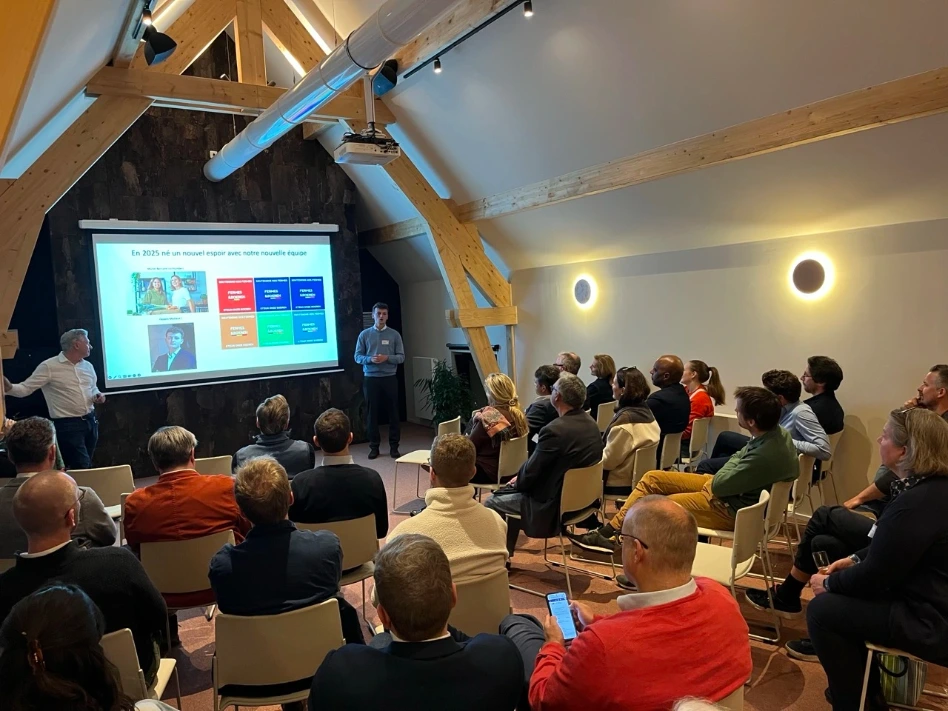
On 5 March 2026, Foster hosted the first conference of its series “From Farm to Fork”, an event dedicated to an essential question: how to reconnect producers and consumers and give meaning back to our food?
In a context where food supply chains are becoming more complex, and where prices no longer always reflect the reality of agricultural work, this evening opened a necessary space for reflection.
🥐 A croissant at €0.22: a symptom of the current food system
A croissant at €0.22 in a supermarket. How is this possible?
It is with this question that Vincent Mefflet, founder of the project Farms & Farmers, introduced the conference.
At that price, it is impossible to pay properly:
producers
processors
quality raw materials
This type of price highlights the imbalances in the current food-processing system, where the pressure on costs mainly affects producers.
A food system dominated by large retailers
Today, 70% of the food basket in Belgium goes through large retailers.
A key figure to understand the stakes:
Large retailers strongly influence the agricultural prices
They structure the food supply chains
They guide the choices of consumers
👉 They can be a barrier to fair remuneration… or a powerful lever to support the local producers and short supply chains
Local agriculture and economy: a strategic issue
The conference broadened the debate beyond food. It raised a fundamental question:what place do we give to agriculture and local production in our economy?
In a context where the economy is heavily oriented towards the tertiary sector, the risk is real: disinvesting in the primary (agriculture) and secondary (processing) sectors
However, these sectors are essential for economic resilience, food security and local sovereignty. As mentioned during the conference: importing products that can be produced locally questions our model. Short supply chains and direct links with producers
Short supply chains and direct links with producers
At the heart of discussions: the need to recreate a direct link between producers and consumers.
The project Fermes & Boeren is part of this dynamic by promoting:
short food supply chains
better traceability of products
a fairer remuneration for producers
an increased transparency for consumers
👉 The objective: to enable everyone to understand what they consume and make more informed choices.
The role of citizens in the food transition
A strong conviction emerged from the evening: the transition to more sustainable food will come from the community
of consumers who prioritise local products
citizens who wish to meet producers
people who are interested in the origin and quality of food
This collective dynamic is essential for evolving practices in the long term.
Foster: a place to think differently about food
With this cycle “From Farm to Fork”, Foster aims to create a space where we can discuss the agricultural and food issues, reflect on more sustainable models and connect the actors: producers, entrepreneurs, citizens.
Because food transformations will not happen on their own, but through meetings and concrete exchanges.
As is often the case at Foster, the evening continued with a convivial moment highlighting some local producers and artisans.
This first conference is just the beginning.
At Foster, we will continue to open these spaces for dialogue to support the transition towards a more sustainable, more local and more conscious food system.